Fuel – OptimOT: Optimized oil transport for PFI dual-fuel combustion of future marine fuels -
Challenges
Alternative marine fuels open up new possibilities for climate-friendly shipping, but at the same time present new challenges for engine developers. In particular, the interactions between fuel, lubricating oil, and the tribological components of the power unit influence the performance, efficiency, and emissions characteristics of modern dual-fuel engines.
To date, there has been a lack of reliable experimental data and suitable simulation models for many of these relationships. This is precisely where the Fuel-OptimOT research project comes in.
Research Focus Areas
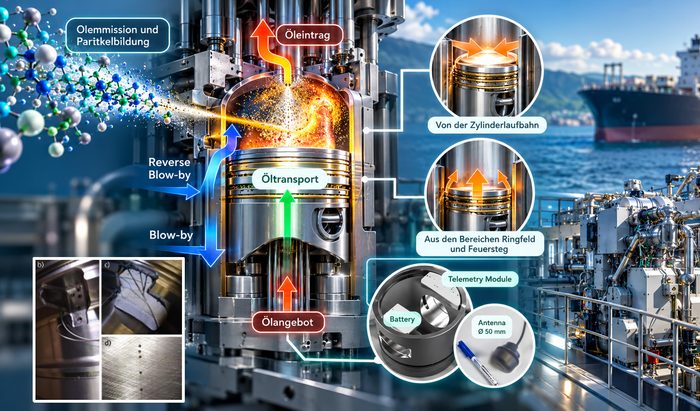
The Fuel-OptimOT project investigates the interactions between alternative marine fuels, the power unit’s tribological system, and oil transport into the combustion chamber. The focus is on medium-speed dual-fuel engines with methanol intake manifold injection and pilot ignition.
The goal is to better understand the underlying oil transport phenomena and to analyze their impact on combustion, emissions, power density, and operational safety. In addition, simulation models are being developed and experimentally validated to enable the efficient design and optimization of future engine concepts.
Project description
The use of climate-friendly fuels such as methanol, ammonia, or hydrogen places new demands on marine internal combustion engines. In particular, the transport of lubricating oil into the combustion chamber has a significant impact on the combustion process, emissions, and the service life of key components. In the Fuel-OptimOT research project, these relationships are being comprehensively investigated for the first time using a medium-speed dual-fuel research engine.
By combining state-of-the-art measurement technology, experimental studies, and numerical simulations, the goal is to better understand the mechanisms of oil transport and optimize them in a targeted manner. The insights gained will help make future marine propulsion systems more powerful, more efficient, and lower in emissions.
Technical Project Objectives
- Analysis of the Performance of a Methanol Dual-Fuel PFI Combustion Process under Marine Operating Conditions.
- To improve understanding of oil transport and oil injection mechanisms in the tribological system consisting of the piston, piston rings, and cylinder liner.
- Development and validation of simulation models to describe oil transport and gas flow within the power unit.
Research Partners
The collaborative project brings together scientific and industrial expertise in the fields of engine development, tribology, combustion technology, and numerical simulation. Under the coordination of MAN Energy Solutions SE, research institutions and industry partners are working together to develop new methods for analyzing and optimizing oil transport in marine dual-fuel engines. The consortium consists of:
- MAN Energy Solutions SE (Project Coordinator)
- IST Engineering Company for Structural Analysis and Tribology, LLC
- Technical University of Braunschweig – Institute for Internal Combustion Engines and Fuel Cells (ivb)
- Clausthal University of Technology – Institute of Technical Mechanics
- Hamburg University of Technology – Marine Engineering Research Group
Research Partners